Sunday, January 24, 2021

Which Dog Breed Is Your Perfect Valentine?

Which Dog Breed Is Your Perfect Valentine? 

Courtesy of Life's Abundance Blog Post 1/18/21


Many would agree that dogs make our lives whole. The love, loyalty, sweet cuddles, and wet kisses are what make us dog people. And just like us, they have their own personalities too! There are the ones that live off of adventure and others that are perfectly content as lap dogs. Here are just a few breeds that have personalities very similar to yourself!


Extroverts

Beagle: Extroverts! What better dog breed to match your outgoing and friendly personalities than a beagle? Beagles are usually an all-around great dog that can adapt to many lifestyles. However, they are extremely intelligent and playful which makes them a great fit for extroverted owners. So, feel free to invite company as beagles will meet them with a happy wagging tail.


Introverts

Shiba Inu: Shiba Inus have a unique personality. They were originally bred as hunting dogs and tend to be a bit possessive. But, just as any breed, they can be trained in a way to be loving family dogs. The reason they make great dogs for introverts is because they are independent and almost “cat-like.” So they are a great match for those who are more to themselves.


Social

Golden Retriever: Goldens fit into so many different categories but they are most definitely a social pup. They are known for being family-friendly and generally getting along with many people. They’re the perfect fit for the social butterfly since they naturally fall in love with just about any visitor that will give them a belly rub and a tasty treat.


Homebody

Maltese: Quite the cute little one in the toy dog group, maltese breeds are fond of cuddling. They still love to play and be active but they don’t require as much activity as other breeds. They make great companions for people who prefer to stay home as they are gentle, loving and are very content being curled up on your lap.


Peaceful

Cavalier King Charles Spaniel: You already know that getting a dog means that there is barking involved. However, there are certain breeds that are less likely to bark, including the Cavalier King Charles Spaniel. If you’re the type of person who enjoys living more peacefully without much noise, this breed is usually more quiet than others. Even excessive yelling doesn’t go over well with these spaniels.


Intellectual

Doberman Pinscher: Looking for a pup that matches your need for knowledge? Dobermans are known for their obedience and intelligence, in fact they are one of the smartest breeds in the world. They respond very well to positive reinforcement so you can feel comfortable training them to sit, stay, or fetch all day long.


Adventurer

Border Collie: Running in the park or hiking up trails, Border Collies are lovers of adventure. They are naturally athletic and are part of the hunting and herding dog groups, meaning that you can bet they are always looking to be where the action is. These dogs will no doubt be up to partnering up with you as you embark on all your outside adventures.


Cuddler

Great Dane: Okay, we know. This sounds absolutely off track. However, despite the Great Dane’s...greatness, they’re actually avid cuddlers. Their size certainly does not stop them from taking a seat on your lap. So, if you’re the type of person who enjoys a rainy day spent snuggled under the covers, then a Great Dane might be the one for you. Just make sure you can take the weight of at least 100 pounds.


Athletes

Parson (Jack) Russell Terrier: Say hello to high energy! If you love going out for a run and spending all your energy, Jack Russels would enjoy being by your side. They are a smaller dog breed that needs to be exercised more than your average pup, they don’t do well just chilling out at home. Also avid hunters, don’t be surprised if they start sprinting after a small animal.


Creative

Poodle: Just take a look at how pet parents get their poodles groomed and you’ll realize they’re a walking canvas on their own - ideal for the creative type. Besides that, poodles are a smart breed that love to be stimulated in different ways. This includes both physical and mental training that ranges from the traditional fetch to becoming a watchdog.


Don’t get us wrong. Just because you might be a huge extrovert, it doesn’t mean you wouldn’t fit well with a Shiba Inu or Great Dane. The amazing thing about dogs is that they will always adore their owner no matter what their personality is. Plus, don’t they always say opposites attract anyways?


If you found this interesting, check out these related stories:


Your Dog Is Paying Attention To Your Emotions


Make Your Dog Happier By Thinking Like One


and don't forget the heart shaped low-fat dog treats (just in time for Valentine's Day) Click Here


Friday, January 22, 2021

Wholesome Heart Low-fat Treats for Dogs

 Wholesome heart low-fat dog treats are ALWAYS popular especially around Valentine's Day because of the heart shape. πŸΎπŸ’–


Life's Abundance Dog Treats Are Awesome ..


CLICK HERE TO PURCHASE NOW

Wholesome Hearts are delicious, low-fat dog treats. They are perfect for dogs that could stand to shed a few pounds and the rich flavor and delicate aromatic spices make them simply irresistible.

  • Proudly made in the USA with high-quality American ingredients.
  • No corn, wheat or soy and their glutens.
  • No artificial colors and no artificial flavors.
  • Fortified with L-Carnitine to help the body utilize fat.
  • Contains multi-grains, fruits and vegetables.
  • With chicken meal, eggs and other wholesome ingredients.
  • Gently baked, heart-shaped treats with a “just from the oven” flavor.

Whether your dog is experiencing a problem with weight, or if you just want to help your pup maintain a trim and healthy figure, you can’t do better than the nutrition of Wholesome Hearts. 

I highly recommend Wholesome Hearts because they are healthy low-fat treats that will satisfy your dog’s desire for a tasty snack in-between meals.


πŸΎπŸ’– πŸΎπŸ’– πŸΎπŸ’– πŸΎπŸ’– 


Rated 4.9 out of 5 based on 57 reviews


Wednesday, January 13, 2021

Midwestern Pet Foods Voluntarily Expands Recall

 Original FDA link, click here

 Midwestern Pet Foods Voluntarily Expands Recall of Pet Food for Aflatoxin Health Risk

Summary

Company Announcement Date:
FDA Publish Date:
Product Type:
Animal & Veterinary
Food & Beverages
Pet Food
Reason for Announcement:
Aflatoxin Levels Exceed Acceptable Levels
Company Name:
Midwestern Pet Foods Inc.
Brand Name:
Sportmix, Nunn Better, ProPac, and Others
Product Description:
Dog and Cat Pet Food

Company Announcement

Midwestern Pet Foods, Inc., of Evansville, IN is expanding its December 30, 2020 voluntary recall of certain dog and cat food products produced in our Chickasha Operations Facility to include all dog and cat pet food products made with corn products because those products may contain aflatoxin levels which exceed acceptable limits. Products were distributed nationally to online distributors and retail stores nationwide. Midwestern Pet Foods is expanding its voluntary recall out of an abundance of caution to help protect the health and safety of pets. The products recalled cover all that expire on or before July 9, 2022, depicted as “07/09/22” in the date code on the product, as discussed below. Products with expiration dates after 07/09/22 are not included in the recall.

Aflatoxin is a toxin produced by the mold Aspergillus flavus, which can grow on corn and other grains used as ingredients in pet food. At high levels, aflatoxin can cause illness and death in pets.

There have been reports of illnesses and deaths in dogs associated with certain lots of products. No human illnesses have been reported. Out of an abundance of caution, we have expanded this recall to cover all corn products containing pet foods with expiration dates prior to 07/09/22.

If your pet shows signs of aflatoxin poisoning including sluggishness, loss of appetite, vomiting jaundice (yellowish tint to the eyes, gums, or skin due to liver damage), and/or diarrhea, contact a veterinarian immediately. Provide a full diet history to your veterinarian. It may be helpful to take a picture of the pet food label, including the lot number and best buy date.

Lot code information may be found on the back of bag and will appear in a three‐line code, with the top line in format “EXP 03/03/22/05/L#/B###/HH:MM”.

As explained above, this recall covers ONLY product manufactured at Midwestern Pet Food’s Chickasha, Oklahoma facility. Note that the unique Chickasha Facility identifier is located in the date code as a
“05” and “REG. OK‐PFO‐0005” at the end of the date code.

In addition, the only Midwestern Pet Foods facility that produces product bearing a three‐line date code is our Chickasha Facility (See first image below).

Retailers and distributors should immediately pull recalled lots from their inventory and shelves. Do not sell or donate the recalled products. Retailers are encouraged to contact consumers who have purchased the recalled products, if you have the means to do so (frequent buyer cards, etc.).

Pet parents: do not feed the recalled products to your pets or any other animals. Destroy the food in a way that children, pets and wildlife cannot access them. Wash and sanitize pet food bowls, cups, and storage containers. Always ensure you wash and sanitize hands after handling recalled food or any utensils which have contacted recalled food. Contact Midwestern Pet Foods Consumer Affairs at 800‐474‐4163, ext. 455 from 7AM to 4PM Central Time, Monday through Friday, or by email at info@midwesternpetfoods.com for additional information.

This voluntary recall is being conducted in cooperation with the U.S. Food and Drug Administration. All other Midwestern Pet Foods products are unaffected by this recall action.

Recalled products are as follows, with lot codes found in Expanded Recall Lot Numbers:

  • Pro Pac Adult Mini Chunk
  • Pro Pac Performance Puppy
  • Splash Fat Cat 32%
  • Nunn Better Maintenance
  • Sportstrail 50
  • Sportmix Original Cat 15
  • Sportmix Original Cat 31
  • Sportmix Maintenance 44
  • Sportmix Maintenance 50
  • Sportmix High Protein 50
  • Sportmix Energy Plus 44
  • Sportmix Energy Plus 50
  • Sportmix Stamina 44
  • Sportmix Stamina 50
  • Sportmix Bite Size 40
  • Sportmix Bite Size 44
  • Sportmix High Energy 44
  • Sportmix High Energy 50
  • Sportmix Premium Puppy 16.5
  • Sportmix Premium Puppy 33


Original Press Release


Company Contact Information

Consumers:
Midwestern Pet Foods Consumer Affairs
 800‐474‐4163, ext. 455
 info@midwesternpetfoods.com

Product Photos


Thursday, January 7, 2021

Off Leash Dog Training

From the Life's Abundance Blog Post 12/31/20 

7 Steps For Off Leash Dog Training


dog training


Training your dog off-leash is a rewarding experience for both you and your pup! However, there are certain precautions you need to take before allowing your dog to roam freely. Off-leash training can be difficult in the beginning, especially for breeds that love to run and investigate their surroundings. It can also be easy for them to get distracted when there are other people and dogs nearby. Here are some steps that will help you in safely leading your furry friend towards their first off-leash adventure.


Off-Leash Training Steps:

  1. First things first is to evaluate if your dog is a good candidate for off-leash training. Some dogs might have more difficulty training, like beagles that love to run or chow chows that tend to be super independent.
  2. Before any training, your dog needs to learn how to sit, heel, and come.
  3. As you guide your dog into training, minimize their fears as best you can. This means making sure the environment is free of loud noises, bigger dogs, or children.
  4. Start off by keeping your dog on a long leash or in a large fenced area. You should not let them off-leash until you are 100% confident they are ready.
  5. Use high-value dog treats or toys as you train your dog to sit, heel, and come. Reward them well and shower them with attention when they complete a behavior.
  6. Over time, you can start to use a drag line, which is a smooth rope attached to a collar or harness, to give them more freedom.
  7. Once they become consistent with commands, you can consider letting them graduate to time off the leash.

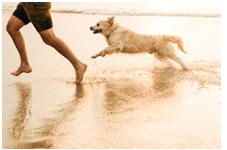
dog on beach with man

The goal of the first several steps is to convince your dog that it is in their best interest to stay close to you and not run off. Sometimes, neutering can make a huge difference as the possibility of roaming decreases by up to 90%. Regardless of this and other factors, like breed, step one above is crucial - each dog should be evaluated for training. 

If your dog constantly runs off, or demonstrates predatory behavior, you will want to involve a professional trainer. Dogs are kept leashed for their safety and the safety of others, so we know there is some risk to going off-leash. But, there is also a big reward for your hard work and consistent effort!


If you found this interesting, check out these related stories:


Dog Training: The Secret to Canine Cooperation


Is Therapy Training Right for Your Dog?


If you are currently a dog trainer and would like to learn about recommending our products to your clients and earning income, please click here


Thursday, December 31, 2020

FDA Recall

Official link to FDA website, click here

Midwestern Pet Foods Voluntarily Recalls Pet Food Recall for Aflatoxin Health Risk

Summary

Company Announcement Date:
FDA Publish Date:
Product Type:
Animal & Veterinary
Food & Beverages
Pet Food
Reason for Announcement:
Elevated levels of aflatoxin
Company Name:
Sportmix
Brand Name:
Sportmix
Product Description:
Dog and Cat Food

Company Announcement

Midwestern Pet Foods, Inc., of Evansville, IN is issuing a voluntary recall of the below listed dog and cat food products due to tests indicating levels of Aflatoxin that exceed acceptable limits. Products were distributed nationally to online distributors and retail stores.

Aflatoxin is a toxin produced by the mold Aspergillus flavus, which can grow on corn and other grains used as ingredients in pet food. At high levels, aflatoxin can cause illness and death in pets.

There have been reports of illnesses and deaths in dogs associated with the below listed lots of Sportmix High Energy. No cat or human illnesses have been reported.

If your pet shows signs of aflatoxin poisoning including sluggishness, loss of appetite, vomiting jaundice (yellowish tint to the eyes, gums, or skin due to liver damage), and/or diarrhea, contact a veterinarian immediately. Provide a full diet history to your veterinarian. It may be helpful to take a picture of the pet food label, including the lot number.

Lot code information may be found on the back of bag and will appear in a three-line code, with the top line in format “EXP 03/03/22/05/L#/B###/HH:MM” as follows (see below in pictures section).

Retailers and distributors should immediately pull recalled lots from their inventory and shelves. Do not sell or donate the recalled products. Retailers are encouraged to contact consumers who have purchased the recalled products, if you have the means to do so (frequent buyer cards, etc.).

Pet parents: do not feed the recalled products to your pets or any other animals. Destroy the products in a way that children, pets and wildlife cannot access them. Wash and sanitize pet food bowls, cups and storage containers.

Contact Midwestern Pet Foods Consumer Affairs at 800-474-4163, ext. 455 from 7AM to 4PM Central Time, Monday through Friday, or by email at info@midwesternpetfoods.com for additional information.

This is a voluntary recall conducted in cooperation with the U.S. Food and Drug Administration.

Recalled lot codes are as follows:

  • 50# Sportmix Energy Plus Lots Exp 03/02/22/05/L2, 03/02/22/05/L3, 03/03/22/05/L2
  • 44# Sportmix Energy Plus Lots 03/02/22/05/L3
  • 50# Sportmix Premium High Energy Lots 03/03/22/05/L3
  • 44# Sportmix Premium High Energy Lots 03/03/22/05/L3
  • 31# Sportmix Original Cat Lots 03/03/22/05/L3
  • 15# Sportmix Original Cat Lots 03/03/22/05/L2, 03/03/22/05/L3

Products may be identified as follows (see below in pictures section):


Company Contact Information

Consumers:
Contact Midwestern Pet Foods Consumer Affairs
 800-474-4163, ext. 455
 info@midwesternpetfoods.com

Product Photos


Tuesday, December 22, 2020

Appreciate the JOY our dogs and cats Bring

 Appreciating The Joys Our Pets Bring

Courtesy of Life's Abundance Blog post of 12/18/20


puppy and kitten


Awesome article by Life's Abundance and Dr. V just explaining the absolute joy and happiness dogs and cats and all our pets bring into our lives.

I don’t know about you, but I’ve spent a ton of time lately with my dog’s head in my lap. I’ve lived with many dogs over the years, but it seems like no matter if I’m petting a lab, a Lhasa, or a coonhound, one fact remains- they always know when I need them there.

This has been an extraordinarily challenging time for everyone, no matter where you live or what you believe. Finding common ground and a sense of unity feels darn near impossible sometimes- until you start talking pets.

Like anyone who’s worked in a field where you interact with the public, I’ve met all kinds of people. One of the things I love most about veterinary medicine isn’t just that the medicine is cool- which it is- but to me, the joy is really in the immense honor and privilege I have in hearing the stories of what pets mean to us.

When I began working as an in-home hospice veterinarian, that took on an even deeper level. Unlike when someone brings a pet into the clinic, I was being invited into their homes to be present for a very momentous moment in their family’s life. I’ve sat on leather couches and corduroy; patio chairs and grassy blankets; sat in joy and sadness and dawn and dusk and no matter who, where, or when I was helping, I felt the same love and connection every time.

cat and dog


With COVID, this connection has taken on even greater meaning, as so many people find themselves spending much more time home in the company of their pets than they ever did before. Here in San Diego, our local Meals on Wheels partners with a rescue organization to deliver pet food to the seniors who rely on the program for healthy meals. Why? Because the volunteers realized many seniors were feeding their meals to their pets, choosing to do without themselves rather than have to give up the companionship of what is, for so many, their main source of emotional support.

When I feel frustrated with the state of humanity and start to wonder if things are as much of a lost cause as it sometimes feels like, I like to think that dogs and cats really do cause us to reveal our true natures. When no one’s watching, how do you interact with your pet? As hard and as rough as things can get, that answer remains constant. We all have the capacity to both give and receive a deep and unconditional love.

This belief has allowed me to be online talking with pet owners all over the world for over a decade, and allowed me to treat every family I encounter with the same dignity and respect. When it feels like there is so little space for common ground, nowhere to start and build upon, this love we share with our pets has consistently served me well for many years, and I hope it does for you as well.


When I first met the Life’s Abundance team and began writing and getting to know you all, I knew right away that this family felt the exact same way I did when it comes to how we honor and love our pets and each other. I’m so grateful to be here with all of you and get to celebrate all the little joys that our pets bring into our lives. Be safe and well!


Dr. Jessica Vogelsang, DVM


Dr. V


If you found this interesting, check out these related stories:

The Many Health Benefits of Living with Dogs

Why People Prefer Cats


and if you are looking for premium food and treats, please check out our Life's Abundance Dog food website


Monday, December 14, 2020

Pet Joint Health

What to Know About Pet Joint Health

Awesome article from Life's Abundance blog post from October 19,2020


dog playing


Age is not a disease.

We say that all the time in medicine, because it’s true. “He’s slowing down” is an observation, but it’s not a diagnosis. All too many times, when I’m asking someone how their pet is doing they will say, “Well, he’s slowing down, but he’s old. What are you going to do?”


Lots! We have lots of things we can do, especially for one of the most common diseases of aging dogs and cats: degenerative joint disease (DJD), also known as osteoarthritis (OA). In fact, one out of five pets are experiencing this right now. And many of them could be feeling a lot better.

DJD is more complicated than it might appear at first blush, but it’s also one of the most gratifying to treat when you’re able to improve a pet’s quality of life so significantly. Whether you have a senior pet with diagnosed or suspected DJD, or a younger pet you want to keep in good health for a good long time, there are things you can be doing right now to maintain their joint health.


Anatomy of a Joint

Unlike a heart or a kidney, a joint is not a discrete organ but a term used to describe the connection between bones. Joints vary in terms of structure, function, and components. Your knee joint, for instance, is a back-and-forth hinge joint, while the joints that connect the bones in your skull move very little. In both cases, this is a good thing.

Joints have multiple components such as cartilage, connective tissue like ligaments and tendons, and capsules that enclose the joint and keep everything contained. Depending on where the joint is located, its purpose is to protect the bones, allow free movement by reducing friction, and act as a cushion.

Cartilage is a critical tissue in the joint. It is comprised of cells called chondrocytes suspended in a matrix of collagen and proteoglycans, which trap water and keep the cartilage nice and plump. Healthy chondrocytes keep that matrix fully hydrated, which is essential for the joint’s ability to absorb forces without damage. Cartilage creates the joint cushion.

The synovial membrane is the tissue that surrounds the joint and keeps it sealed. The membrane secretes synovial fluid into the joint, which is critical for lubrication.

If there is any disruption to the cartilage, the synovial membrane, or the bone underneath the cartilage, your dog or cat can begin to develop a joint disease.


Causes of DJD

While DJD can result from the normal aging process, it is often accelerated in pets by an injury or other underlying health condition that causes stress or inflammation. Inflammatory compounds in the joint space disrupt the cartilage matrix, reducing its ability to retain water. As the cartilage dehydrates, it starts to become more brittle and rubbery, like a piece of cheese you left out overnight. It also becomes more likely to splinter. If it gets bad enough, the underlying bone can also be affected.


cat playing


Treatment and Prevention

Unfortunately, DJD in dogs and cats is an irreversible process. Treatment is aimed at slowing down the progression of the disease, reducing pain, and maintaining movement in the joint. It is a complex process with a lot of different elements, which means one thing: the best treatment hits the disease process on multiple fronts. We call this ‘multimodal disease management,’ and it’s the gold standard in DJD therapy. Here are the different fronts from which we attack DJD:

1. Anti-inflammatories. Remember when I mentioned those inflammatory compounds? There are a lot of them. No one medication or supplement gets them all, which is why we tend to combine them for better results.

  • NSAIDS- These are the most recognizable of the bunch for most of us, and are nice because they reduce both inflammation and pain. In pets, these are prescription meds such as Rimadyl, Metacam, or Deramaxx. Please don’t use over the counter people medications like Advil or Aleve- they simply aren’t as effective and can be dangerous to your pets.
  • Nutraceuticals and supplements- This is an ever-expanding group of treatments that gets lots of attention for being effective across many species, with a low incidence of side effects. The most recognizable names here are glucosamine/ chondroitin sulfate, but newer players on the market such as green lipped mussels are also giving great results.
  • Adequan injections- This is an injection available through veterinarians that stimulates the cartilage to improve the matrix.


2. Weight loss. If your pet is overweight- which describes about half the pets in the US! -this can accelerate the stress that causes cartilage to degenerate. If your pet is overweight, talk to your vet about what their ideal body weight should be. If they are the correct weight, well done! Keep it up.

3. Alternative treatment modalities. I trained and became certified in veterinary acupuncture specifically to treat arthritic pets, with good results. I’ve also used lasers, a product that uses pulsed electromagnetic fields, and physical therapy. The more layers you add onto your treatment, the better the results.

4. Prevention. Unfortunately, by the time a pet starts to limp or shows signs of pain, they have usually had DJD for some time and it is fairly advanced. That’s why preventive measures are so important. Here’s what pet owners should do from the get-go:

  • Maintain a healthy weight for your pet.
  • Maintain a regular exercise program to keep joints mobile and healthy.
  • Keep your pet on a healthy diet and add omega-3 fatty acids, which have anti-inflammatory properties.
  • If your pet is highly active or in a higher-risk category for DJD, consider adding nutraceuticals and supplements to their diet sooner rather than later.


Age isn’t a disease, but DJD is. It’s not often I say, “the more the merrier!” when it comes to treatments, but in this case you really can’t begin joint healthcare early enough. From diet to exercise to supplements, put your plan in place now to keep your pet in good health long into their senior years!


Wishing you and your family health and happiness,


Dr. Jessica Vogelsang, DVM


Dr. Vogelsang, DVM